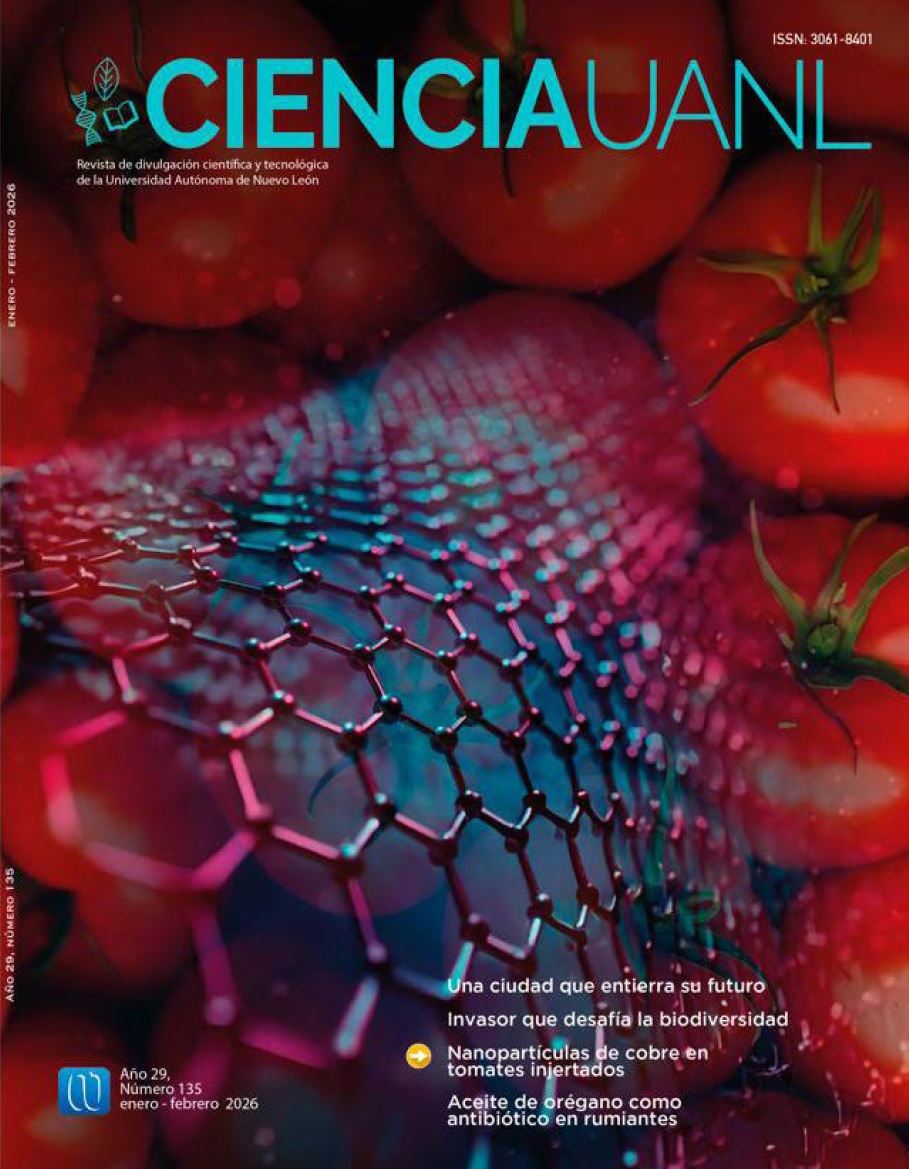
Nanopartículas de cobre y su efecto en el crecimiento y la clorofila de tomates injertados
DOI:
https://doi.org/10.29105/cienciauanl28.135-4Palabras clave:
fisiología vegetal, estrategias agronómicas, micronutrientes, tecnología experimentalResumen
El cobre es esencial en procesos fisiológicos de las plantas, su aplicación como nanopartículas de cobre (NPCu) puede mejorar el desarrollo vegetal. Este estudio evaluó el efecto de cuatro dosis de NPCu (0, 20, 60 y 100 ppm) y tres tipos de injerto en tomate bajo condiciones controladas. El objetivo fue analizar su impacto en altura, diámetro de tallo y contenido de clorofila. Los resultados mostraron variaciones asociadas al tipo de injerto, mientras que las NPCu no evidenciaron sinergia positiva con injertos. Se recomienda ampliar el número de repeticiones y considerar mediciones fisiológicas más precisas para comprender mejor los efectos de las NPCu en la fotosíntesis.
Descargas
Citas
Bayoumi, Yousry, Shalaby, Tarek, Abdalla, Zakaria F., et al. (2022). Grafting of Vegetable Crops in the Era of Nanotechnology: A photographic Mini Review, Environment, Biodiversity and Soil Security, 6(2022), 133-148. DOI: https://doi.org/10.21608/jenvbs.2022.147280.1181
Aqeel, Umra, Aftab, Tariq, Khan, M. Masroor A., et al. (2023). Excessive copper induces toxicity in Mentha arvensis L. by disturbing growth, photosynthetic machinery, oxidative metabolism and essential oil constituents, Plant Stress, 8, 100161. DOI: https://doi.org/10.1016/j.stress.2023.100161
Davis, Angela R., Perkins-Veazie, Penelope, Hassell, Richard, et al. (2008). Grafting effects on vegetable quality, HortScience, 43(6), 1670-1672, http://doi.org/10.21273/hortsci.43.6.1670 DOI: https://doi.org/10.21273/HORTSCI.43.6.1670
Jahagirdar, Ajinkya S., Shende, Sudhir S., Gade, Aniket K., et al. (2019). Bioinspired synthesis of copper nanoparticles and its efficacy on seed viability and seedling growth in mungbean (Vigna radiata L.), Current Nanoscience, 16(2), 246-252. http://doi.org/10.2174/1573413715666190325170054 DOI: https://doi.org/10.2174/1573413715666190325170054
Jalali, K., Nouairi, Issam, Kallala, Nadia, et al. (2018). Germination, seedling growth, and antioxidant activity in four legume (Fabaceae) species under copper sulphate fungicide treatment, Pakistan Journal of Botany, 50(4), 1599-1606.
Li, Yaping, Shi, Shuqian, Zhang, Ya, et al. (2023). Copper stress-induced phytotoxicity associated with photosynthetic characteristics and lignin metabolism in wheat seedlings, Ecotoxicology and Environmental Safety, 254, 114739. DOI: https://doi.org/10.1016/j.ecoenv.2023.114739
Maceda, Agustín, Soto-Hernández Marcos, Peña-Valdivia, Cecilia B., et al. (2022). Lignina: composición, síntesis y evolución, Madera y bosques, 27(2), https://doi.org/10.21829/myb.2021.2722137 DOI: https://doi.org/10.21829/myb.2021.2722137
Naika, H. Raja, Lingaraju, K., Manjunath, K., et al. (2015). Green synthesis of CuO nanoparticles using Gloriosa superba L. extract and their antibacterial activity, Journal of Taibah University for Science, 9(1), 7-12, http://doi.org/10.1016/j.jtusci.2014.04.006 DOI: https://doi.org/10.1016/j.jtusci.2014.04.006
Pádua, Mario, Cavaco, Ana M., Aubert, Serge, et al. (2010). Effects of copper on the photosynthesis of intact chloroplasts: interaction with manganese, Physiologia Plantarum, 138(3), 301-311. DOI: https://doi.org/10.1111/j.1399-3054.2009.01335.x
Sayed, Eman G., Mahmoud, Abdel W. M., El-Mogy, Mohamed M., et al. (2022). The effective role of nano-silicon application in improving the productivity and quality of grafted tomato grown under salinity stress, Horticulturae, 8(4), 293. DOI: https://doi.org/10.3390/horticulturae8040293
Shalaby, Tarek A., Bayoumi, Yousry, Abdalla, Neama, et al. (2016). Nanoparticles, soils, plants and sustainable agriculture. In: S. Ranjan, N. Dasgupta, & E. Lichtfouse, (Eds) Nanoscience in food and agriculture 1, Springer, Berlin, 283-312, http://doi.org/10.1007/978-3-319-39303-2_10 DOI: https://doi.org/10.1007/978-3-319-39303-2_10
Singh, Dharam, Nath, Kamlesh, Sharma, Yogesh K. (2007). Response of wheat seed germination and seedling growth under copper stress, Journal of Environmental Biology, 28(2), 409-414.
Sullivan, Brooke K., Keough, Michael, Govers, Laura L. (2022). Copper sulphate treatment induces Heterozostera seed germination and improves seedling growth rates, Global Ecology and Conservation, 35, e02079, http://doi.org/10.1016/j.gecco.2022.e02079 DOI: https://doi.org/10.1016/j.gecco.2022.e02079